AMANDA NADELBERG: Your first book, The Lesser Fields, is an entire universe unto itself, and it's filled with some of the most beautiful descriptions of the natural world I've seen—creeks, ponds, fish, trees, honey, horses, hay and duckweed, for instance; it's also full of family units and story (but with story comfortably forgetting a few of its details to make for Better Stories) and directions (read: maps, possibly related to Story) and this amazing and particular myth-making that emerges believable while still strange. Could you talk about these poems and address any of these elements, if they seem familiar to you?
ROB SCHLEGEL: I spent most of my childhood living near the edge of Mr. Maller's twenty acre woods on the eastern slopes of the Oregon coast range. I whacked beehives with sticks and was stung. I wrapped vines around the trunks of trees, not realizing the vines were poison ivy. So its possible that the creeks, ponds, fish and trees in The Lesser Fields are the after-images of those landscapes and animals which helped inform my relationship to language and perception. That said, it took me a few months away from the book to actually see its relatively haunted undercurrents. Seeing them for the first time actually startled me a bit. It was as if I had come across an animal I once knew that was now decomposing.
The final section in the book contains poems that were written after my friend (poet Brandon Shimoda) came to live in my backyard for a spell. So often, Brandon's very presence creates an atmosphere of creative and artistic stimulation. At the time, my wife was away in Mexico for a month, so I basically spent that time (once Brandon left) writing these poems in complete solitude. A lot of the poems were born during that hypnogogic state just before we fall asleep, when the cerebral filters that are generally in place when we're awake, begin to soften and our minds seem more flexible, open, perhaps even, less our own.
AN: In some of your newer poems, there is more city alongside the nature: casinos, towers, theaters (of mollusks!) manmade clouds and commuting and it's striking how it all snuck in so easily, like a cousin to the world in The Lesser Fields, but not that world exactly. How have these new poems evolved? Were there changes in your process, and how do you feel about sonnets?
RS: At the risk of sounding a bit reductive and oversimplistic, I feel that this distinction might stem from reading more and more of the first generation New York School poets (not that Schuyler/Ashbery necessarily avoid the natural world). Once I read O'Hara's THE DAY LADY DIED through Geoffrey G O'Brien's lens in his seminar THE END OF THE POEM, the city suddenly became a place that contained as many (if not more) tensions between my psyche and language as the natural world contained for me in The Lesser Fields. It's likely also the result of actually spending more time in cities, the man-made clouds revealed themselves as I drove from Midwestern city to Midwestern city last fall.
The conversations in Geoffrey's class also got me thinking more and more about form. Many of the sonnets actually began as variations on Hopkin's eleven line curtal sonnets. Since then, I've "sewn" (as a smart friend said) a few of the eleven line sonnets together and then began carving away the excess. Many of the sonnets have been informed by Robert Pogue Harrison's mind-blowingly beautiful book The Dominion of the Dead, as well as some writings of Alberto Giacometti and the two-headed philosopher Deleuze and Guattari.
AN: Do you have socks with lightning bolts on them?
RS: One red pair with white boltz; one green pair with yellow boltz.
AN: One time I saw you read a poem to Lake Erie via skype to some people in a library in a small midwestern city. How did that awesome come about? Do you collaborate often? How do you feel towards the interwebs?
RS: Just after moving to Iowa City, I began to feel some relatively heavy anxiety about living so far from the Oregon that I love. When I lived in Missoula, it was easy to imagine myself still very close to my home state (the state that I used to say, as a highschool kid, I would "fight" for, should it ever need to protection--from what, I had no idea, and still don't). Anyway, I asked a few friends to write poems addressed to Lake Erie that I would read to the lake, and then wait for the lake's response. At its core, this project considered the consequences of departure, arrival, integration and reintegration, as well as explorations of the limited and limiting definitions of “audience” and “reader” in the context of the traditional structures that persist in most reading venues today. Additionally, as a new resident of the Midwest (from the Pacific Northwest, a region that helped sustain me physically, emotionally and artistically) I wanted to explore how voluntary departures and subsequent arrivals felt like minor segmentations of awareness Thus, the delivery of these five texts through my own body and throat was an attempt to move beyond the need to feel as though I was "comfortable" in this new place and toward an appreciation for the fact that these texts (as they were delivered) inhabit/deliver me. To this end I hoped to create some semblance of symmetry around the edges of unease; here and not here, having arrived and arrived nowhere.
AN: At times, there seems to be a more public face in the newer work, but then other times I'm reading, I take it all back, thinking there's a more private logic in the sonnets than in The Lesser Fields, with the act of myth-making in your first book being a generous inclusion for the reader. How do you think about the public vs. private in poetry and/or how do you think of audience if/when you do?
RS: Indeed, I can see what you're saying about the sonnets maybe having a more private logic and I can't help but think that working within the form only allows for a more intense immersion into the psyche--you know--the whole idea that the more structure you have in your life, the more willing you might be to actually wander into those parts of your mind you might not otherwise have the guts to visit. I wonder if those are the private parts of mind? Ultimately, I think many of the sonnets seem to be sitting someplace between the public and private. Perhaps somewhere in the "middle" as Deleuze might say in his Dialogues.
AN: You and your wife, Kisha, started The Catenary Press? Pray tell!
RS: Kisha and I started The Catenary Press when we realized that there weren't very many places for poets to publish serial-work. We wanted to create a venue for that. And so far, the first two publications have nearly sold out. This fall we plan to publish one or two more chapbooks (though we're still trying to figure out which).
AN: What did you have for breakfast?
RS: I am currently living in my sister's basement in Portland. So this morning I ate: Granpola (a homemade granola mix my grandfather invented); yogurt; a few Hood strawberries my sister bought at the Sellwood farmer's market; green-tea in a white cup.
AN: A year ago you moved from Missoula to Iowa City. How you have experienced the changes in terms of landscape, staircases, neighborhood, rainfall, culinary delights and transportation?
RS: Iowa City and the midwest in general, seems like a remarkably comfortable place to live. A friend of mine said that the midwest makes you "own up" to being an American. Which feels about right. That said, the writing community in Iowa City has been tremendously welcoming, and I think this is due, in large part, to the ANTHOLOGY READING SERIES.
AN: Some people really like the summer. What will you do this summer?
RS: I'm reading books for a seminar I'm teaching next year tentatively titled The Post-Modern Post-Trauma: Readings in Contemporary Fiction. So far: L.Davis, Murakami, Dellilo, Millet, McCarthy. I'm also wallowing in the loss of a few good friends who won't be returning to Iowa City next year. The coasts are calling them; they may very well be calling me as well.
Rob Schlegel's The Lesser Fields was selected for the 2009 Colorado Prize for Poetry. Born and raised in Portland, Oregon, he has lived in California, Montana and Iowa. He currently teaches at Cornell College and is publisher of The Catenary Press.
Amanda Nadelberg is the author of Bright Brave Phenomena (forthcoming from Coffee House Press) and Isa the Truck Named Isadore (Slope Editions, 2006) as well as a chapbook, Building Castles in Spain, Getting Married (The Song Cave, 2009).
Friday, June 25, 2010

Tuesday, June 22, 2010
Studio One is on July 2nd with Rob Schlegel, Cassandra Smith & Craig Santos Perez
Check it out:

Craig Santos Perez, a native Chamoru from the Pacific Island of Guahan
(Guam), is the co-founder of Achiote Press (www.achiotepress.com) and
author of two poetry books: from unincorporated territory
(Tinfish Press, 2008) and from unincorporated territory [saina]
(Omnidawn Publishing, 2010). He received an MFA from the University of
San Francisco and is currently a Ph.D. candidate in Comparative Ethnic
Studies at the University of California, Berkeley.
Cassandra Smith works with a combination of fixing and making things.

 Rob Schlegel's The Lesser Fields was selected for the 2009 Colorado Prize for Poetry. Born and raised in Portland, Oregon, he has lived in California, Montana and Iowa. He currently teaches at Cornell College and is publisher of The Catenary Press.
Where?
Studio One Art Center
365 45 St
Oakland
Cross: Broadway
When?
doors 7
reading 730
How much?
Entry by donation

Craig Santos Perez, a native Chamoru from the Pacific Island of Guahan
(Guam), is the co-founder of Achiote Press (www.achiotepress.com) and
author of two poetry books: from unincorporated territory
(Tinfish Press, 2008) and from unincorporated territory [saina]
(Omnidawn Publishing, 2010). He received an MFA from the University of
San Francisco and is currently a Ph.D. candidate in Comparative Ethnic
Studies at the University of California, Berkeley.
Cassandra Smith works with a combination of fixing and making things.

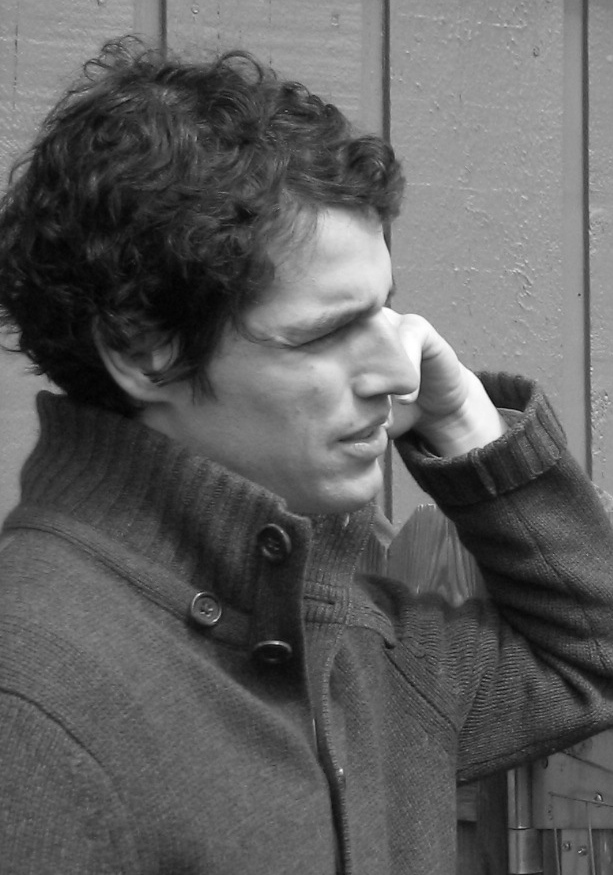 Rob Schlegel's The Lesser Fields was selected for the 2009 Colorado Prize for Poetry. Born and raised in Portland, Oregon, he has lived in California, Montana and Iowa. He currently teaches at Cornell College and is publisher of The Catenary Press.
Where?
Studio One Art Center
365 45 St
Oakland
Cross: Broadway
When?
doors 7
reading 730
How much?
Entry by donation
Wednesday, June 16, 2010

Friday, June 4, 2010
Emily Kendal Frey talks with Alisa Heinzman for June 4th's reading
EMILY KENDAL FREY: If I described your poetry as "hesitatingly brave" would that resonate for you?
ALISA HEINZMAN: I feel like I don't know what brave means. Actually, I feel like I don't know what a lot of words mean lately. Calling the poems brave feels really funny to me. They address events that I found and find painful, so if that means they're brave I would think it's in a way that a lot of peoples' poems are.
EKF: Your poems, especially those from the "Brother in the Field" series handle biography with such quiet command, and I appreciate so much the way your images offer themselves to the space they occupy. For example,
Our grandparents,
kind in their distance.
The hard-starched collars, the flag-heavy video.
Am I late? It seems I am.
These lines are bald, unflinching, and evenly applied-- the softest opaque. People (grandparents) and things (collars, flags, video) do exist. Your world is an actual world. But the speaker seems to float within this real world, neither judging or participating in it fully. ("Am I late. It seems I am.") There's a resigned bravery there.
AH: I think that's a nice way to put it, sometimes floating within the real world. That seems like a common yet totally weird experience, especially during intense and difficult times, right? Like telling jokes in hospital waiting rooms, or feeling like you have to have a decidedly sad face at funerals. It's just impossible to feel fully and properly at the times you're supposed to. So then when do you freak out? In the bathroom, on the bus, at the grocery store. It's been years since I've read it, but isn't that a part of Camus' The Stranger? The guy's mom dies and he can't seem to act properly like "a grieving son". Most of these poems are written about memories of my brother going to Iraq as a medic, and as I wrote them I realized that in pretty much every situation I felt inappropriate and inadequate. Too aware of myself as a part of this public event with so many other families going through the same thing, but also, of course, feelings of terrible privateness.
EKF: What's it like to write poems like these? How do you approach biography in poetry?
AH: Honestly, I'm really looking forward to not writing poems like these at some point. Or at least not poems that overtly address events I was involved with with my family. It feels really complicated. The poems are about me, about my feelings and responses to events because in many ways that's all I can write about here. I'm not in the military and all I can know about my brother's experiences is what he tells me. So there's some of that, things he talked and wrote about, but I tried to deal mostly with myself because that's all I can really know.
EKF: What do you do with the personal when it intersects the political?
AH: The issue of the political, and the political where it insects biography is an ongoing source of anxiety. I've had so many terrible feelings about it. Like using the words war and soldier and deployment and uniform...these words are just huge. They are so difficult. But the public-ness and the political aspect of these experiences are integral to the experiences, so writing poems that completely ignored this--poems that just addressed an absence or something like that, or abstracted the events--felt all wrong. I had so many fights with myself like, "really, are you really going to use the word war again?" and "why can't I use the word war? It's a war isn't it?" But the big words feel distancing, so I was/am always conflicted.
I think it's hard, too, because political poems (and really, I'm not sure what exactly constitutes a political poem) get a bad rap for a lot of good reasons. There's the risk of being a sort of "speaker outside the event" that looks in and judges without being culpable or present. I don't know. Lately I've really liked looking at Wave Book's State of the Union. There's this great range of poems there that deal with the political, the public, whatever, in really thoughtful ways.
EKF: How do you include someone else in a poem without being exploitative?
AH: I really have no idea. This has also been such a concern for me in these recent poems. If to exploit is just to put to use then I'm trying to think of it as, In these particular poems, I put my memories to use and my memories involve other people. Really, over and over, I keep thinking that the best solution I have right now is to focus on myself, be certain the speaker is always a version of me, which sounds, maybe, selfish. But really, if what's there is what comes in through my own eyeballs and ears and hands, then I can be responsible for that, or at least I can answer for that in some way.
EKF: What's your relationship to reading? I know that my relationship to reading (poetry, and all texts) shifts constantly, and I'm always in conversation with myself as a reader, not just a writer. Any current favorite poets or writers?
AH: Reading is definitely a big part of writing for me. I think this is especially true when I'm trying to work through difficult parts of a poem, or think about how to approach the sometimes vague poem-blob in my head in some way...to think of how someone else did it in a way that felt successful to me. The books of poetry that have affected me most strongly in the last several months would definitely be WS Merwin's The Lice, and more recently, Susan Howe's Souls of the Labadie Tract. I memorized a couple of short Merwin poems last month and have been thinking about how reading impacts my writing most when it really inhabits my brain, my day to day thoughts when I'm waiting in line or something, thinking about how a poem looks or feels or wondering at a really weird, magic moment in it, and then trying to bring something of that love to my own writing. Of course, it doesn't always transfer.
Emily Kendal Frey lives in Portland, Oregon and teaches at Portland Community College. She is the author of Airport (Blue Hour 2009), Frances (Poor Claudia 2010), and The New Planet (Mindmade Books 2010).
Alisa Heinzman lives in Oakland. She co-edits the journal CALAVERAS with Sara Mumolo, and is the poetry editor for MARY Magazine. She will graduate from Saint Mary's College of California's MFA program this month and has several poems forthcoming in the SF Public Press.
Sunday, May 23, 2010
Vincent Standley talks with Sandy Florian for Studio One's reading on Friday, June 4th
Vincent Standley: Repetition is central to all of your work. In Prelude to Air from Water, it operates not only on the level of the line but of the structure of the work as a whole. It would be easy to say each piece is a variation on a theme, but that usually excludes the idea of repetition by assuming each variation extends from some kind of master iteration of the theme. In Prelude, rather than extending from something, the pieces are set side-by-side in a sort of static refusal of their origin, making repetition the thing by which we understand or don't understand their similarities and differences. I'm curious if there's an implicit questioning of the idea that knowledge, like progress, develops over time toward a better or more complete condition?
Sandy Florian: Well, if you are asking ask whether I think knowledge might be tied to an origin, tied to some knowledge event from which it rises like an optimistic stock price, or whether I think knowledge in its static repetition is more like the skyline of a city of identical buildings, then I would answer that the book is a sort of stupid skyline, or that doesn’t believe in knowledge at all. None of the "moments" that are encountered in the book lead to epiphany, cumulative or not. And those episodes where The Moment doesn't appear, when small epiphanic moments can be said to occur, well, those episodes are actually dream episodes, or episodes that are submerged in the unconscious that has no real sense of time, even though that's not necessarily meant to be clear to the reader. So, in that sense, the book refuses awareness of its characters, though it is hyper aware of itself, and with this hyper awareness, it permits the reader a knowledge that is separate from any literal knowledge discovered in the book.
But it’s funny, this question of repetition in my work. Because I never intend to use repetition. Prelude started as one little episode with The Moment in it. After I wrote it, I realized it was done, but not done - finished, but incomplete. So I wrote another only to find the pair was finished but not complete. So I kept writing them over and over in a sort of meditation until it taught me something about itself, about the vanity of knowledge, its ludicrousness or its hubris. But I had to learn it, I suppose, and therein lies the tension of knowledge.
VS: The space of not knowing while writing is very powerful and necessary. It's as if you must first learn from the work before enforcing a set of objectives, even though in practice that order is often reversed. How do you negotiate between what the work teaches about itself and what you want it to do?
SF: I know this is probably weird, but there is usually no "me" in my books. Okay, I take that back. I am in the work, but only to kink out the phonetics, to smooth out the sentences, to hear it out loud, and make it sound. But in terms of content, I don't ever start out with any objectives. I learn entirely from the writing what the writing wants. My books inform themselves, and I completely trust them. Even The Tree of No, with its "knowledge event" and seemingly strategized narrative. I did some research, yes, and toyed a lot with dictionaries and the bible, of course, but I toyed only because the book informed the process. So, in that sense, all I carry to the page when I write is faith.
VS: This reminds me of something Maurice Blanchot writes in "The Essential Solitude": "To write is to make oneself the echo of what cannot cease speaking - and since it cannot, in order to become its echo I have, in a way, to silence it. I bring to this incessant speech the decisiveness, the authority of my own silence. I make perceptible, by my silent mediation, the uninterrupted affirmation, the giant murmuring upon which language opens and thus becomes image, becomes imaginary, becomes a speaking depth, an indistinct plenitude which is empty. This silence has its source in the effacement toward which the writer is drawn."
I noticed that Francisco Aragon interviewed you a while back for the Institute of Latino Studies at the University of Notre Dame. In response to the question "Are you comfortable with the label Latino Writer?," you say the work would be dishonored without the identity of your Latino heritage, while personally the identity is less important. Can you expand on this distinction between work and author?
SF: Well, yes, I can try to expand. I think my work is hugely informed by my heritage, but my heritage is distinctly not homogeneous. Yes, my heritage is Latino, but it’s a hybrid between Colombia and Puerto Rico, two lands that have distinctly different cultures. To complicate matters, I was raised not in Colombia or Puerto Rico but in Venezuela and Mexico and Panama. And because my father worked for a French company when I was young, I spent my summers in France. I went to college in London. It sounds fancier than it is because it wasn’t necessarily fancy. Still, who I am is informed by where I’ve been.
Yes, my work tends to draw, I think, from the magical realism of writers like Garcia Marquez, the Kafkaesque attitudes of writers like Borges, the problematic proesy of Galeano, but this isn’t because I’m a big follower of their styles, per se. It’s more, I think, because the Latino culture is markedly fanatical. Distinctly involved with the impossible, the invisible, the peripheral, the intensely problematical, and these are borders I enjoy crossing. So yes, I think my work is distinctly Latino.
As far as my own identity, though, I’m not sure. This is possibly because it’s more difficult for me to look at myself than it is to look at my work, and even in my work, every time I have characters who can look at themselves, they tend to incriminate themselves, or to dismember themselves, as many of my characters in On Wonderland and Waste. Perhaps I prefer to reside in the interstices of culture, navigating my way to myself. But perhaps this interstitial preference too is Latino. That I wouldn’t argue against for a moment.
VS: What are you working on now?
SF: It’s called Boxing the Compass, and it’s a winner! It’s a pro-feminine, Virigina Woolfish, character driven, event disclosing, creative nonfictionesque novel/novella with progressive narrative and sequential chapters galore. It focuses on science, on the ecological devastation of the oceans and how it affects the psychology of my everywoman character. I'm in the middle of it and hope to finish it by September. Stay tuned.
The other book I am working on is a collaboration with Robert Savino Oventile called Sophia Lethe Talks Doxobox Down. And it's turning out to be a fantastically morbid collection of dialog, each using specific rhetorical devices. It's a gas, and I love both of these books.
Sandy Florian is the author of 5 books of prose poetry: Telescope, 32 Pedals & 47 Stops, The Tree of No, Prelude to Air From Water, and On Wonderland & Waste. She lives in San Francisco where she is an affiliate artist at the Headlands Center for the Arts and one of the "other" editors for Tarpaulin Sky Journal.
Formerly the editor of 3rd bed, Vincent Standley's fiction has appeared in Colorado Review, Denver Quarterly, Encyclopedia, Esquire, Parakeet, Post Road, Quarterly West, and Salt Hill Journal. Essays have appeared in Rules of Thumb: 71 Authors Reveal Their Fiction Writing Fixations and Oxford Encyclopedia of American Literature.
Wednesday, May 19, 2010
Friday June 4th with Alisa Heinzman and Sandy Florian. Music from Mark E. Deutsch.
check it out:

Alisa Heinzman lives in Oakland. She co-edits the journal CALAVERAS with Sara Mumolo, and is the poetry editor for MARY Magazine. She will graduate from Saint Mary's College of California's MFA program this month and has several poems forthcoming in the SF Public Press.
Mostly interested in being honest and playful, Mark E. Deutsch is a musician whose genre could best be described as Personal Soup Pop. Instead of ignoring other, lesser genres, Deutsch tends to imitate and use various strains of popular music (e.g. broadway jazz ballads, reggae, blues rock) and thereby transform them via homemade low-tech techniques and his own casual delivery. As Paul Simon imitates South African pop on Graceland, so Mark imitates Paul Simon's imitation of South African pop on Graceland and keeps the old Wheel of Cultural Anthropophagy a'spinnin'. Deutsch recently finished an album called Soft Outfit, as well as a recording project for his baby nephew called Song for the Sabra. Currently he's working on an album/performance called Karaoke. Much of his music is available for free at markedeutsch.bandcamp.com and you can follow his blog at januaryhairs.blogspot.com.
 Sandy Florian is the author of 5 books of prose poetry: Telescope, 32 Pedals & 47 Stops, The Tree of No, Prelude to Air From Water, and On Wonderland & Waste. She lives in San Francisco where she is an affiliate artist at the Headlands Center for the Arts and one of the "other" editors for Tarpaulin Sky Journal.
doors 7
reading 730
donation for entry!
365 45th st
Oakland
bart: MacArthur

Alisa Heinzman lives in Oakland. She co-edits the journal CALAVERAS with Sara Mumolo, and is the poetry editor for MARY Magazine. She will graduate from Saint Mary's College of California's MFA program this month and has several poems forthcoming in the SF Public Press.
Mostly interested in being honest and playful, Mark E. Deutsch is a musician whose genre could best be described as Personal Soup Pop. Instead of ignoring other, lesser genres, Deutsch tends to imitate and use various strains of popular music (e.g. broadway jazz ballads, reggae, blues rock) and thereby transform them via homemade low-tech techniques and his own casual delivery. As Paul Simon imitates South African pop on Graceland, so Mark imitates Paul Simon's imitation of South African pop on Graceland and keeps the old Wheel of Cultural Anthropophagy a'spinnin'. Deutsch recently finished an album called Soft Outfit, as well as a recording project for his baby nephew called Song for the Sabra. Currently he's working on an album/performance called Karaoke. Much of his music is available for free at markedeutsch.bandcamp.com and you can follow his blog at januaryhairs.blogspot.com.

 Sandy Florian is the author of 5 books of prose poetry: Telescope, 32 Pedals & 47 Stops, The Tree of No, Prelude to Air From Water, and On Wonderland & Waste. She lives in San Francisco where she is an affiliate artist at the Headlands Center for the Arts and one of the "other" editors for Tarpaulin Sky Journal.
doors 7
reading 730
donation for entry!
365 45th st
Oakland
bart: MacArthur
Tuesday, May 11, 2010
Some video of Lynn Xu at Studio One's May 7th Reading
Hey Lucas thanks for taping this
see more videos from L. Rivera here
Lynn Xu reads at Studio One from Lucas M. Rivera on Vimeo.
see more videos from L. Rivera here
Subscribe to:
Posts (Atom)